Short answer: In India, wear loose, light clothing that covers your shoulders and knees in towns, temples and anywhere outside a beach resort. Cotton or linen trousers, long skirts, loose shirts and a scarf cover almost every situation for men and women. Add a fleece and a warm jacket for Delhi and Rajasthan in December–January and for the Himalaya in any month, and pack a rain layer for June to September. Shoes come off at every temple, so choose ones that slip on and off.
Quick answer (checked 30 October 2026)
- The one rule: shoulders and knees covered in cities, villages and places of worship. Shorts, vests and strappy tops are for beach resorts and hotel pools.
- Temples and gurdwaras: shoes off (deposit counters charge about ₹5–20 or are free), head covered at Sikh gurdwaras for everyone, no leather at Jain temples, trousers or a dhoti for men at the stricter South Indian temples (Travel India Smart dress-code guide, checked 30 Oct 2026).
- Mosques: Jama Masjid in Delhi lends cotton robes at the gate for a small fee if you are under-dressed; women cover hair.
- Fabrics: cotton and linen from March to October; merino or fleece layers and a down or padded jacket for the plains in December–January and the hills year-round.
- Footwear: slip-on sandals or trainers you can remove in seconds; closed shoes for the mountains and for Varanasi’s ghats.
- Buy there: a kurta (long shirt) and cotton trousers cost about ₹500–1,500 (US$5–16) in any market and solve the dress question for the rest of the trip.
Plan this trip with a local operator
We are a local operator, registered with HP Tourism (see our certificates). Tell us your dates and route and we will send a packing note for the season along with a Golden Triangle or Himachal plan with a private car and English-speaking driver. WhatsApp +91 70874 88961 (WhatsApp works internationally) · info@suzutravels.com
What is the dress code in India for tourists?
There is no legal dress code for visitors, and in Mumbai, Delhi’s malls, Goa’s beaches or a Bengaluru cafe you will see Indians in anything from saris to shorts. What there is instead is a strong social norm, stronger in small towns and in the north than in big cities and the south, that adults keep shoulders and knees covered in public. Following it is not about rules; it is about how you are treated. In our experience a traveller in long trousers and a loose shirt gets fewer stares, fewer hassles and better service than one in shorts and a vest, and that applies to men nearly as much as to women.
The second norm is modesty over style. Tight or sheer clothing attracts more attention than a bare arm. Loose is both cooler and more respectful, which is why the local answer to the heat, the kurta and cotton trousers (or salwar kameez for women), has lasted so long.
This guide is about what to wear; our India packing list covers everything else to bring, from adaptors to medicines, and our first-time India guide covers the other norms worth knowing.
What to wear in India by place: cities, temples, mountains and beaches
| Place | Women | Men | Notes |
|---|---|---|---|
| Cities and towns (Delhi, Jaipur, Agra, Varanasi, Amritsar) | Loose trousers or long skirt, top covering shoulders, a scarf (dupatta) to add cover at temples | Long trousers or chinos, shirt or T-shirt with sleeves | Shorts on men are tolerated in tourist areas but read as beachwear; leggings alone are seen as underwear |
| Hindu temples | Shoulders and knees covered, no sleeveless tops; scarf for the head is welcome but rarely required | Trousers, sleeved shirt; some South Indian temples ask men to wear a dhoti and remove the shirt in the inner shrine | Shoes off at the gate; leather belts and wallets not allowed inside some sanctums; socks fine |
| Sikh gurdwaras (Golden Temple) | Head covered with a scarf, shoulders and knees covered | Head covered (orange patkas are handed out free at the entrance), long trousers | Shoes deposited free, feet washed in the channel at the entrance; no tobacco or alcohol on the premises |
| Mosques (Jama Masjid Delhi, Taj Mahal mosque) | Long sleeves, long trousers or skirt, hair covered | Long trousers, sleeved shirt | Robes lent at Jama Masjid for a small fee; shoes off |
| Jain temples (Ranakpur, Palitana, Dilwara) | As Hindu temples; no leather at all | As Hindu temples; remove leather belt, watch strap, wallet | Lockers at the gate; menstruating women are asked not to enter at some sites |
| Himalaya (Shimla, Manali, Dharamshala, Ladakh) | Trousers, layers, fleece, warm jacket, beanie; dress norms are relaxed in Manali and McLeod Ganj | Same layers; shorts fine on treks | Closed shoes; sun protection at altitude; temples and monasteries still need covered shoulders |
| Beaches (Goa, Kerala, Andamans) | Swimwear on the beach and at the pool; cover up with a sarong or dress to leave the sand | Swim shorts on the beach; T-shirt in town | Topless and nude sunbathing are illegal; Kerala’s public beaches are more conservative than Goa’s |
The temple and gurdwara rules above follow the Travel India Smart guide to dress codes at religious sites (checked 30 October 2026) and our own experience taking clients through Amritsar, Varanasi and the Rajasthan temples. For the Golden Temple in detail, including the langar and the night ceremony, see our Golden Temple visiting guide.
What should women wear in India?
The combination that works almost everywhere: loose cotton or linen trousers (wide-leg, or the local salwar or palazzo style), a top that covers the shoulders and ideally the upper arm and reaches below the hips, and a large light scarf. The scarf does three jobs: it covers the head in gurdwaras and mosques, adds cover over a T-shirt at a temple, and keeps the sun off on a fort wall. A long skirt or a midi dress with sleeves works as well. Avoid tops that gape at the neckline, strappy tops worn alone, and leggings without a long top over them.
Many women buy a kurta or a salwar kameez in the first market they reach: a cotton set costs roughly ₹800–2,000 (US$8–21) at Fabindia or Anokhi, less in a bazaar, is cooler than anything brought from home, and changes how you are received in small towns. Jeans with a long kurta is a common look among Indian women in the cities and is fine for visitors. A sports bra and quick-dry trousers are better than shorts for treks in Himachal.
In big cities and tourist resorts standards relax: in South Delhi, Mumbai, Goa and the backpacker streets of Old Manali, McLeod Ganj and Rishikesh you will see shorts and vests on travellers and locals alike. Our guide for solo female travellers in India covers attention and how dress affects it; the short version is that dress reduces it but does not remove it.
What should men wear in India?
Long lightweight trousers or chinos and a shirt or T-shirt with sleeves. Linen or cotton shirts are cooler than T-shirts in the heat and look right at a hotel restaurant. Shorts are tolerated in tourist spots and the hills but mark you out, and they are not allowed in most temples and the stricter mosques; carry a pair of trousers in the daypack if you wear shorts for a walk. A cotton kurta over trousers is a comfortable local option that costs about ₹500–1,200 (US$5–13).
For the Golden Temple, Jama Masjid and most South Indian temples, men need the same cover as women. At a few orthodox South Indian temples, such as Madurai’s Meenakshi temple or Thanjavur’s Brihadeeswara, men must wear trousers or a dhoti rather than shorts, and in the inner sanctum of some temples men remove the shirt. Guides at the gate sell or lend dhotis if needed.
What to wear in India by season
| Months | Plains (Delhi, Agra, Rajasthan, Varanasi) | Himalaya (Shimla, Manali, Dharamshala) | South and coasts (Kerala, Goa) |
|---|---|---|---|
| Dec–Feb | Warm days (about 15–25°C), cold mornings and nights (single figures in Delhi in late Dec–Jan): layers, a fleece and a light down jacket for the Taj Mahal at sunrise | Snow and sub-zero nights: padded jacket, thermals, gloves, hat, waterproof boots; snow boots and suits can be hired in Manali | Warm and dry: cotton, swimwear, a light layer for AC and evenings |
| Mar–May | Hot to very hot (35–45°C by May): the lightest cotton and linen, a hat, sunglasses, long sleeves against the sun | Pleasant days, cool nights: trousers, fleece, light jacket; snow still at the passes | Hot and humid: cotton, sandals |
| Jun–Sep | Monsoon from late June: quick-dry fabrics, a light rain jacket or umbrella, sandals that can get wet | Rain in Himachal; Ladakh and Spiti dry: rain shell, warm layer, closed shoes | Heavy monsoon in Kerala and Goa: as plains |
| Oct–Nov | Warm, dry days, cooler evenings: cotton by day, a light layer at night; Diwali (8 Nov 2026) is a good excuse to wear something bought locally | Clear and cold at night: fleece and jacket; first snow possible at altitude | Second monsoon in Kerala in Oct–Nov; Goa dries out from November |
Temperatures are typical ranges, not forecasts. Our best time to visit India guide has the month-by-month detail, and for the cold end, India in January and Manali in January describe what the weather actually feels like. Serious trekking and climbing kit is a separate subject; see our guide to what to wear on a Himalayan climb.
Which shoes should you bring to India?
You will take your shoes off more often than anywhere else you have travelled: at every temple, gurdwara and mosque, at the Taj Mahal mausoleum (shoe covers are included with the foreign ticket), in many homes and some shops. So the main pair should slip on and off without laces: leather or sports sandals, loafers, or slip-on trainers. Bring a thin pair of socks for hot marble at midday and for the Golden Temple’s wet floors. Closed walking shoes are needed for the Himalaya, for Varanasi’s ghats, and for any fort with uneven steps (Amber, Mehrangarh, Kumbhalgarh). Flip-flops are fine for the beach and the hotel, not for a day in Old Delhi.
What should you wear for Holi, weddings and festivals?
For Holi (Monday 22 March 2027), wear old white clothes you are happy to throw away, as the colour never comes out, and cover your hair with a scarf or oil it. Keep valuables in a zip pocket. Our Holi festival tour page explains where to play safely. For a wedding invitation, a kurta or sherwani for men and a sari, lehenga or salwar kameez for women can be hired or bought cheaply, and the hosts will be delighted; bright colours are expected and black and white are avoided. At Diwali, new clothes are traditional, and a bazaar kurta is enough to join in.
What should you not wear in India?
- Camouflage or military-pattern clothing, which is restricted for civilians and attracts police attention.
- Anything with religious images, Hindi slogans you cannot read, or the national flag.
- Leather inside Jain temples and some Hindu sanctums; leave belts and wallets in the car.
- Shorts, vests or strappy tops at any place of worship, in villages, or at the Wagah border ceremony.
- Expensive jewellery and watches on display in crowded markets and stations; the issue is not dress but theft. Our guides to safety in India and common tourist scams cover the rest.
Frequently asked questions
Can women wear shorts in India?
In Goa, resort hotels, Mumbai and the backpacker streets of Manali, McLeod Ganj and Rishikesh, yes. In most towns, villages and anywhere near a temple, shorts draw stares and sometimes comments, and they are not allowed in places of worship. Loose cotton trousers or a long skirt are as cool and far more comfortable socially. Carry a scarf for temple visits.
Can men wear shorts in India?
Shorts are tolerated in tourist areas and in the hills, but they mark you as a tourist and are refused at most temples, the Golden Temple and the big mosques, where long trousers are required. Many of our male clients wear light long trousers all day and find them cooler than expected. Keep a pair in the daypack if you walk in shorts.
Do you have to cover your head in India?
Only at Sikh gurdwaras, where everyone, men and women, covers their head (free head scarves are available at the gate of the Golden Temple), and at mosques, where women cover their hair. At Hindu temples a head covering is welcome but not usually required. Shoes come off at all of them.
What should I wear to the Taj Mahal?
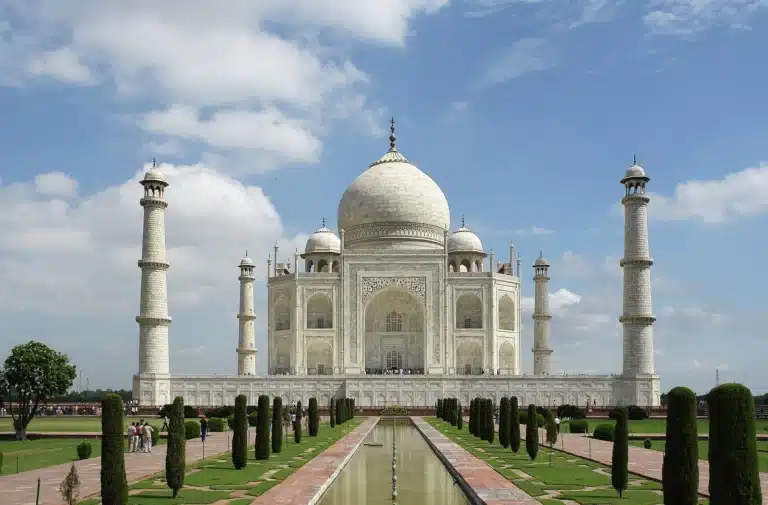
There is no formal dress code, but you walk a long way on open marble, so wear comfortable slip-on shoes (shoe covers for the mausoleum come with the foreign ticket), a hat and sunglasses, and in December–January a warm layer for the dawn opening. The mosque beside the mausoleum follows mosque norms of covered shoulders and knees. Tripods and food are not allowed inside.
Is it OK for tourists to wear Indian clothes?
Yes, and it is appreciated rather than seen as costume. A kurta with trousers, or a salwar kameez, is what many Indians wear every day, costs about ₹500–2,000 in a market, and is cooler than most western clothing. Avoid wedding-grade embroidery for sightseeing and save saris for an occasion where someone can help you tie one.
What should I wear in India in winter?
On the plains (Delhi, Agra, Jaipur, Varanasi) December and January bring warm afternoons around 20°C but cold, often foggy mornings near 5–8°C, so pack layers, a fleece and a light jacket for sunrise visits. In the Himalaya expect snow and sub-zero nights; bring thermals, a padded jacket, hat, gloves and waterproof boots, or hire snow gear in Manali.
Plan this trip with a local operator
We are a local operator, registered with HP Tourism (see our certificates). Tell us your dates and route and we will send a packing note for the season along with a Golden Triangle or Himachal plan with a private car and English-speaking driver. WhatsApp +91 70874 88961 (WhatsApp works internationally) · info@suzutravels.com