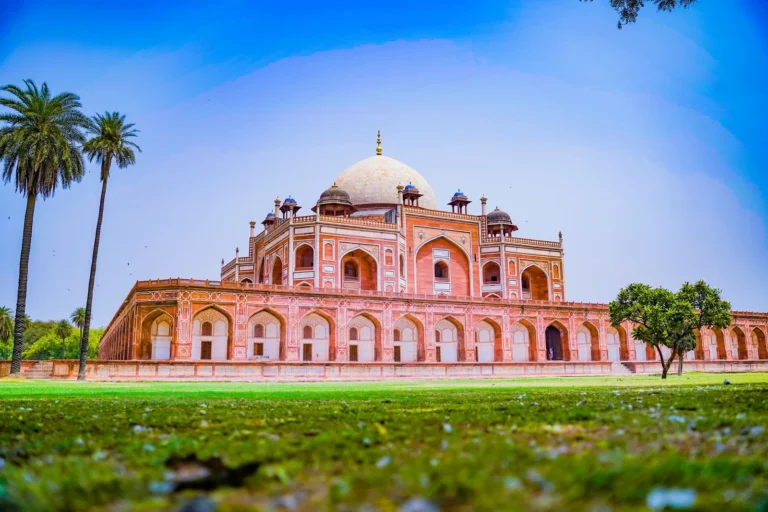

Short answer: Fatehpur Sikri is the red sandstone capital that the Mughal emperor Akbar built from 1571 and abandoned within fifteen years, 40 km west of Agra on the road to Jaipur. It is a UNESCO World Heritage Site (1986) in two parts: the ticketed palace complex (₹610 for foreign visitors, ASI) and the free Jama Masjid with the 54 m Buland Darwaza gate and Salim Chishti’s marble tomb. Allow two to three hours, and visit it on the drive between Agra and Jaipur rather than as a separate trip.
Quick answer (checked 30 October 2026)
- Where: 40 km west of Agra (about 1 hour), 195 km east of Jaipur (3.5 hours), just off the NH-21 Agra–Jaipur highway.
- Tickets: palace complex ₹610 for foreign visitors, ₹600 on Fridays; Indian citizens ₹50; children under 15 free; the mosque and Buland Darwaza are free (ASI Agra ticketing, checked 30 Oct 2026).
- Hours: sunrise to sunset daily, including Fridays; last entry about 30 minutes before sunset.
- Time needed: 2–3 hours for both parts; 90 minutes if you are in a hurry.
- Getting in: cars park below the ridge and a shuttle bus or short walk takes you up; private vehicles cannot drive to the gates.
- Watch out for: self-appointed guides and cloth sellers around the mosque; hire a licensed guide at the ticket office instead (roughly ₹300–₹500).
Plan this trip with a local operator
We are a local operator, registered with HP Tourism (see our certificates). Every Golden Triangle tour we run stops at Fatehpur Sikri on the Agra–Jaipur day, with a private car and English-speaking driver who knows the parking, the shuttle and which gate to use. WhatsApp +91 70874 88961 (WhatsApp works internationally) · info@suzutravels.com
What is Fatehpur Sikri and why was it abandoned?
In 1569 Akbar, the third Mughal emperor, had no surviving son. He visited the Sufi saint Salim Chishti, who lived in a village called Sikri on a ridge west of Agra, and the saint foretold an heir. When the boy (the future emperor Jahangir, named Salim after the saint) was born the following year, Akbar built a new capital on the ridge in gratitude. Work began in 1571 and the court moved in by 1573; the name Fatehpur, “city of victory”, came after Akbar’s conquest of Gujarat.
By 1585 the court had moved on to Lahore and the city was never a capital again. The usual explanation is that the water supply, an artificial lake below the ridge, failed; another is simply that Akbar’s wars moved north-west and the capital went with him. Whatever the cause, Fatehpur Sikri was left almost intact, which is why it is the best-preserved Mughal city in India and a UNESCO World Heritage Site since 1986. Unlike Agra Fort, which was altered by every emperor after Akbar, what you see here is one man’s taste in one decade: Persian planning, Hindu and Jain carving, and the open, experimental mind of an emperor who held religious debates in his own audience hall.
What should you see in the palace complex?
The ticketed area is the imperial palace, a sequence of courtyards and pavilions along the ridge. A licensed guide helps, because many buildings have names that are later inventions and the signage is thin. In the order most guides take it:
| Building | What it was | What to look for |
|---|---|---|
| Diwan-i-Am | Public audience courtyard | The emperor’s screened pavilion on the west side; the scale of the court |
| Diwan-i-Khas | Private audience hall | The single central pillar with 36 brackets supporting a platform where Akbar sat, bridges radiating to the corners; the building most photographed after the gate |
| Anup Talao | Ornamental tank | A square pool with a central platform where the musician Tansen is said to have performed |
| Panch Mahal | Five-storey pleasure pavilion | 176 columns, each storey smaller than the last, open to the wind; originally screened for the women of the court |
| Turkish Sultana’s House | Small pavilion by the tank | The densest carving on the site: forests, animals and vines cut into sandstone like wood |
| Jodha Bai’s Palace | The largest residence, for the senior queens | Hindu temple brackets, a tulsi courtyard, blue-glazed tile fragments on the roof |
| Birbal’s House and Mariam’s House | Residences in the women’s quarter | Carved brackets; traces of painted murals in Mariam’s House |
| Hiran Minar | Tower outside the palace walls | Studded with stone elephant tusks; optional, five minutes’ walk beyond the main complex |
Names like “Jodha Bai” and “Birbal’s House” are traditional rather than documented, and a good guide will tell you so. The palace is open sandstone with little shade, so in summer do it first, before 10:00, and keep water with you.
What should you see at the Jama Masjid and Buland Darwaza?
The mosque is a separate enclosure beside the palace, still in use, and free to enter; you remove shoes at the gate (there are shoe-minders who expect a few rupees) and cover shoulders and knees. Three things make it worth the detour.
The Buland Darwaza. The “Gate of Magnificence” on the south side, 54 m high including its steps, built in 1601 to mark Akbar’s Gujarat campaign and one of the largest gateways in the world. You climb a steep flight of steps from the village side; from the top the Agra plain spreads out below. The inscription on the arch, in Persian, records a saying attributed to Jesus: the world is a bridge, pass over it but build no house upon it.
The tomb of Salim Chishti. A small white marble tomb in the great courtyard, with lattice screens so fine they look like lace, built in 1580–81 and refaced in marble by Jahangir. It is an active shrine: women who want children tie threads through the screens, and there is usually music. Go in, quietly, and give a small donation if you wish; nobody is obliged to buy the embroidered cloth (chadar) that sellers will press on you outside.
The mosque itself. The prayer hall on the west side, with a central mihrab decorated in glazed tile and inlay, is one of the finest Mughal mosques and usually empty of tourists.
This is also the part of the site where unofficial “guides” attach themselves to visitors, often claiming to be descendants of the saint and steering you to shops. Be polite and firm, or arrive with a licensed guide hired at the ticket office (about ₹300–₹500 for the full site) so there is nothing to argue about.
How much does Fatehpur Sikri cost and when is it open?
Under the Archaeological Survey of India tariffs on the official Agra ticketing page (checked 30 October 2026), the palace complex costs ₹610 for foreign nationals and ₹600 on Fridays; Indian and SAARC citizens pay ₹50 (₹40 on Fridays); children under 15 enter free. The Jama Masjid, Salim Chishti’s tomb and the Buland Darwaza are free. Tickets are sold at the ASI counter below the palace gate and online through the ASI’s Agra Circle site, which saves a queue in the winter season. The site is open from sunrise to sunset every day, including Fridays, which makes it a useful fixture on a Friday when the Taj Mahal is closed.
Private cars are not allowed up to the monuments. You park in the designated car park on the highway side (a small fee), and a shuttle bus or a 10–15 minute walk takes you up to the ticket gate; the arrangements change from time to time, so follow your driver’s advice on the day. Camel carts and tongas offer the same ride for a negotiated fare.
How do you fit Fatehpur Sikri into a Golden Triangle trip?
| Option | How it works | Time cost | Verdict |
|---|---|---|---|
| On the Agra–Jaipur drive | Taj at sunrise, leave Agra about 09:30, Fatehpur Sikri 10:30–12:30, lunch at Bharatpur, Abhaneri stepwell, Jaipur by evening | Adds about 2.5 h to a 4–5 h drive | The standard plan; what we do on every 5-day and 7-day itinerary |
| Half-day trip from Agra | Leave Agra 08:00, back by 13:00 | About 5 h round trip | Good if you have two nights in Agra and are not going on to Jaipur |
| Day trip from Jaipur | 195 km each way, 3.5 h | 7 h of driving | Not worth it on its own; combine with a move to Agra |
| Train from Agra | Slow passenger trains to Fatehpur Sikri station, 1 km from the site | Unpredictable | Only for determined rail fans; a car is easier |
The Agra–Jaipur road is covered stop by stop in our Agra to Jaipur guide, including the Keoladeo bird sanctuary at Bharatpur 20 km further on, which is worth an hour from October to February. If you are spending two nights in Agra, our guide to things to do in Agra beyond the Taj shows how a half-day to Sikri fits with the Fort and Mehtab Bagh. Our comparison of 4, 5 and 6-day Golden Triangle tours shows which lengths leave time for it.
When is the best time to visit Fatehpur Sikri?
October to March, in the morning. The site is an exposed sandstone ridge with almost no shade, so by noon in April–June the stone is too hot to sit on and the courtyards are empty for good reason; in those months be at the gate at opening. In winter the red stone glows in low morning light and the Buland Darwaza steps are busiest between 11:00 and 14:00, when the Agra day-trip coaches arrive. Fridays are quieter in the palace (the ₹10 discount is a sign of that) but busier at the mosque for prayers; both are still open. Our month-by-month Golden Triangle guide has the weather for the whole route.
Practical tips from our drivers
- Carry small notes for the shoe-minder at the mosque and the shuttle; nothing here takes cards except the ticket office.
- Wear shoes you can slip off, and bring a scarf for the mosque.
- Do not follow anyone offering a “short cut” into the palace from the mosque side; the ticket gate is the only legitimate entry, and the ASI checks tickets inside.
- There is a reasonable ASI-run and a few village restaurants near the car park, but the better lunch is at Bharatpur, 20 km on, or at one of the highway hotels towards Jaipur.
- If a child under 15 is with you, say so at the counter: entry is free (ASI).
- Combine the visit with a sunrise at the Taj: our Taj Mahal sunrise guide explains how to be out of Agra by 09:30 and still have seen the Taj properly.
Frequently asked questions
How far is Fatehpur Sikri from Agra and Jaipur?
About 40 km west of Agra, an hour by car, and about 195 km east of Jaipur, roughly 3.5 hours. It lies just off the NH-21 highway that links the two cities, which is why nearly every Golden Triangle itinerary visits it on the Agra-to-Jaipur driving day rather than as a separate trip.
How much is the entry fee at Fatehpur Sikri?
₹610 for foreign visitors and ₹600 on Fridays, ₹50 for Indian and SAARC citizens, free for children under 15, under Archaeological Survey of India tariffs checked on 30 October 2026. The ticket covers the palace complex only; the Jama Masjid, Salim Chishti’s tomb and the Buland Darwaza gate are free to enter.
How long do you need at Fatehpur Sikri?
Two to three hours covers the palace complex and the mosque with a guide, including the climb up the Buland Darwaza steps. Ninety minutes is enough for the highlights if you are pressed for time on the drive to Jaipur. Add 20–30 minutes for parking and the shuttle or walk up to the gate.
Is Fatehpur Sikri open on Fridays?
Yes. Both the palace complex and the mosque are open every day from sunrise to sunset, including Fridays, when the Taj Mahal is closed. The palace fee for foreign visitors drops from ₹610 to ₹600 on Fridays. The mosque is busier at Friday midday prayers, so visit it in the morning or late afternoon.
Why was Fatehpur Sikri abandoned?
Akbar built it from 1571 as a new capital after the Sufi saint Salim Chishti foretold the birth of his heir, and left it by 1585. The most common explanation is that the artificial lake supplying water failed; another is that Akbar’s campaigns in the north-west drew the court to Lahore. Either way, the city survived almost untouched.
Do I need a guide at Fatehpur Sikri?
It helps. The palace buildings carry traditional names that need explaining and signage is sparse. Hire a licensed guide at the ASI ticket office for roughly ₹300–₹500 and politely decline the unofficial guides who gather around the mosque, who usually steer visitors to shops. With a licensed guide the whole site takes about two hours.
Plan this trip with a local operator
We are a local operator, registered with HP Tourism (see our certificates). Every Golden Triangle tour we run stops at Fatehpur Sikri on the Agra–Jaipur day, with a private car and English-speaking driver who knows the parking, the shuttle and which gate to use. WhatsApp +91 70874 88961 (WhatsApp works internationally) · info@suzutravels.com