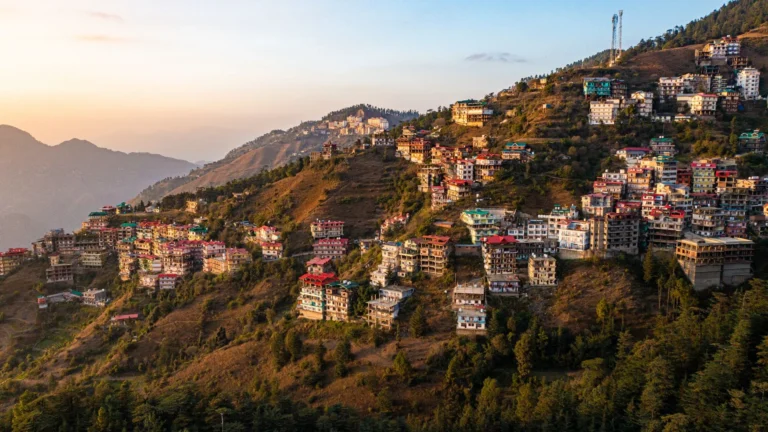


Shoja: forest, snow peaks and quiet trails below Jalori Pass
A tiny hamlet high in the Banjar valley, a few kilometres below Jalori Pass, with big Himalayan views, cottage stays and easy walks to a sacred lake and a ruined fort.
- ~2,690 m Shoja
- ~5 km to Jalori Pass
- ~10 km above Jibhi
- Dec–Feb snow likely
Updated November 2026 · HP Tourism registered travel agent · Reg. No. DTO-MND-11-243/2022 · certificates
Shoja is a small hamlet at about 2,690 m in the Banjar valley of Kullu district, roughly 10 km above Jibhi and 5 km below Jalori Pass (about 3,120 m). It is quieter and higher than Jibhi, with cottages and homestays among oak and deodar forest and wide views of the Great Himalaya on clear days. From Jalori two easy trails lead to Serolsar Lake (about 5 km, through forest) and Raghupur Fort (about 3 km, open meadows with views). Shoja usually gets snow from late December to February, when the road over Jalori is often closed; the Shoja–Jibhi side generally stays reachable with care. March–June and October–November are the easiest months. Shoja is about 500 km from Delhi via Aut and Banjar.
- HeightAbout 2,690 m; Jalori Pass about 3,120 m.
- DistancesJibhi ~10 km, Banjar ~20 km, Aut ~50 km, Delhi ~500 km.
- WalksSerolsar Lake (~5 km from Jalori), Raghupur Fort (~3 km from Jalori).
- SnowLate December – February; Jalori road often closed after snowfall.
- Best monthsMarch – June, October – November.
Jibhi and Tirthan weather today
Jibhi (about 1,900 m) and Tirthan (about 1,600 m) are below Shoja; Shoja and Jalori are 800–1,200 m higher and several degrees colder. Current temperature and the next days’ high, low, rain and snow.
Forecast data: MET Norway (CC BY 4.0), refreshed about once a day — last update —.
Things to do in Shoja
Jalori Pass (about 3,120 m) is a short drive or walk above Shoja, with a small temple, tea stalls and a view over the ridges of Outer Seraj. It is the starting point for the two best-known walks in the area — see our Jalori Pass guide.
Serolsar Lake: an easy, mostly level trail of about 5 km through oak forest leads from Jalori to a small, sacred lake with a temple of Budhi Nagin. Allow 3–4 hours return. Raghupur Fort: about 3 km the other way, a gentle climb to open meadows and the ruins of an old fort, with views of the snow peaks on clear days.
In Shoja itself there is little to do but walk, read and look at the view — which is the point. The Great Himalayan National Park lies just to the north, and Tirthan and Jibhi below have rivers, waterfalls and village walks.

Best time to visit Shoja
Shoja is high enough for real winter. Here is what each season brings.
| Season | Weather | What to expect |
|---|---|---|
| March – June | Mild days, cool nights | Rhododendrons, clear trails, Jalori open |
| July – September | Monsoon rain and mist | Lush forest; landslides possible on the Aut–Banjar road |
| October – November | Clear, crisp days | Best views of the snow peaks |
| December – February | Snow and sub-zero nights | Jalori road often closed; snow walks around Shoja |
Valley weather pages: Jibhi weather · Tirthan valley.
How to reach Shoja
From Delhi: by road to Aut (on the Chandigarh–Manali highway), then through the tunnel side road to Banjar, Jibhi and up to Shoja — about 500 km, 11–12 hours. Overnight buses from Delhi go to Aut; from there a local car or bus continues to Banjar. The nearest airport is Bhuntar (Kullu), about 70 km away. See also Kullu–Manali airport.
In winter the stretch above Jibhi can be icy; travel in daylight with a driver used to snow, and check whether Jalori is open if you plan to cross towards Ani and Shimla.
Shoja, Jalori and Serolsar in pictures
The Himalaya from Jalori, Shoja village, Serolsar Lake, Raghupur Fort and the forest in snow — real photographs, each credited to its photographer.


Around Shoja
Combine Shoja with the valley below.
Chehni Kothi
A tall old timber-and-stone tower in a village.
Shamshari Mahadev
Carved wooden temple in Outer Seraj.
Our Tirthan, Jibhi and Shoja trips
Cottages, meals and a private car, in one quote.
Planning Shoja, Jibhi or Tirthan?
Tell us your dates, where you are starting from and how many of you are travelling. We check the roads and Jalori and send a written quote with cottages and a private car. Suzu Travels is a travel agent registered with HP Tourism, based in Bilaspur, Himachal Pradesh.
Shoja: frequently asked questions
Where is Shoja?
In the Banjar valley of Kullu district, about 10 km above Jibhi and 5 km below Jalori Pass.
Does it snow in Shoja?
Yes, usually from late December to February.
Is Jalori Pass open in winter?
It is often closed after snowfall, usually from about late December to March; check before you travel.
How far is Serolsar Lake from Jalori?
About 5 km one way on an easy forest trail.
Shoja or Jibhi — where should I stay?
Jibhi is lower, livelier and by the river; Shoja is higher, quieter and better for views and snow.
How far is Shoja from Delhi?
About 500 km, 11–12 hours by road via Aut and Banjar.
Sources
Photo credits
The Himalaya from above Shoja — Photo: Sankara Subramanian from Bangalore, India, CC BY 2.0 · A slate roof in Shoja — Photo: Tanvi.sharmaaa, CC BY-SA 4.0 · The range from Jalori — Photo: Prabhmeet Singh, CC BY-SA 4.0 · The view towards GHNP — Photo: Manish57335, CC BY-SA 4.0 · Serolsar Lake — Photo: Sukhjiwan Singh, CC BY-SA 4.0 · Raghupur Fort in snow — Photo: Gannu03, CC BY-SA 4.0 · Snow on the forest — Photo: Ayis.ha200*21, CC0 · Cloud in the valley — Photo: Ayis.ha200*21, CC0 · Shamshari Mahadev temple — Photo: Aniket Alam, CC BY-SA 4.0