
Manimahesh Kailash Yatra: Dates, E-Pass, Trek & How to Reach
मणिमहेश कैलाश यात्राTo Shiva's lake below Chamba Kailash.
The late-summer walk from Bharmour to Manimahesh Lake, a glacial lake at about 4,080 m beneath the peak of Manimahesh Kailash. What we know about 2027, the online e-pass, the trek via Dhancho and Gauri Kund, the two holy baths and how to plan safely.
- 2027 dates not announced yet
- E-pass online, compulsory since 2026
- ~13–14 km trek from Hadsar
- ~4,080 m lake altitude (about)
- Aug–Sep Janmashtami to Radha Ashtami
What is the Manimahesh Yatra and when is it in 2027?
The Manimahesh Yatra is Himachal’s pilgrimage to Manimahesh Lake, about 4,080 m up below the peak of Manimahesh Kailash in Bharmour, Chamba district. It is held in Bhadon (Aug–Sep), from Janmashtami to Radha Ashtami. The 2027 dates are not announced yet. Since 2026 every pilgrim needs an online e-pass, and the trek from Hadsar is about 13–14 km.
Manimahesh — the jewel of Mahesh — is a high glacial lake in the Bharmour subdivision of Chamba district, Himachal Pradesh. Above it rises Manimahesh Kailash, also called Chamba Kailash, which the Gaddi shepherds of these valleys revere as one of Shiva’s homes. A small shikhara shrine stands on the shore with a brass image of Mahishasuramardini and a four-faced Shiva. The Himachal government has declared the yatra a state-level pilgrimage, and it is counted among the Panch Kailash with Kinner Kailash, Shrikhand, Adi Kailash and Mount Kailash.
Pilgrims take the nhaun, the holy dip, in the lake and walk around it. By custom men bathe in the larger, colder Shiv Karotri and women at Gauri Kund, a little short of the lake on the trail. Many pilgrims first pray at the centuries-old Chaurasi temples of Bharmour. If you are coming from the Kangra side, you can visit Chamunda Devi and Kangra Devi on the way. Climbers can read about the peak on our mountains of Himachal page. See all our guides on the pilgrimage tours page.
The legend of Manimahesh
These are the local traditions of the Gaddi people and of Chamba, retold in our own words — beliefs held with love, not history.
- Shiv BhumiThe Gaddi shepherds of Bharmour call these valleys Shiv Bhumi, Shiva’s own land, and believe Manimahesh Kailash is one of his homes.
- A lake from his hairIt is said that Shiva meditated here for ages, and that the lake formed from water flowing out of his matted hair.
- Behind the waterfallAnother story says Shiva hid behind the Dhancho waterfall from the demon Bhasmasura, until Vishnu tricked the demon into destroying himself — so the falls too are held sacred.
- The jewel on the peakOn rare clear dawns or full-moon nights, a glow on the summit is believed to be the mani, the jewel on Shiva’s crown. Some explain it as light reflecting off the glacier.
Gaddi belief also holds that Shiva leaves Kailash on Janmashtami and returns around Mahashivratri. Out of reverence, people avoid climbing the peak itself; no first ascent is recorded.
Manimahesh Yatra dates: 2026 and 2027
| What | Date | Status / source |
|---|---|---|
| Manimahesh Yatra 2027 | Not announced yet | DC Chamba usually notifies the window in July–August |
| Radha Ashtami 2027 (royal bath) | 8 Sep 2027 (by panchang) | The yatra traditionally ends on Radha Ashtami — a pattern, not an announcement |
| Manimahesh Yatra 2026 | From 25 Aug 2026 | Official window announced by the district; e-pass registration opened 5 Aug |
| Chhota Nhaun 2026 | 4 Sep 2026 | The small holy bath, on Krishna Janmashtami |
| Bada / Shahi Nhaun 2026 | 19 Sep 2026 | The royal bath on Radha Ashtami, which concluded the yatra; about 80,000 pilgrims |
The lake is frozen roughly from October to June. Outside the official window, Manimahesh is a trek only, with guides and local permission. We will update this page when 2027 is announced (checked 14 Nov 2026).
The Bharmour route to Manimahesh Lake
Distances are approximate. Most pilgrims drive to Bharmour, continue to the road head at Hadsar and walk up via Dhancho.
-
~59 kmChamba to Bharmourभरमौर
About 2.5 hours on a hill road. Pray at the Chaurasi temples, the ~84 shrines of Bharmour.
-
~13 kmBharmour to Hadsarहड़सर
The road head and the e-pass check point. Ponies and porters start here.
-
HaltDhanchoधन्छो
Most pilgrims spend the night here, by the sacred waterfall. Langars run in the season.
-
~13–14 km in allGauri Kund to the lakeमणिमहेश झील
Past Gauri Kund to Manimahesh Lake at about 4,080 m — the holy dip and the walk around the lake.
Other traditional routes come over high passes from Kugti (Lahaul side) and from the Kangra–Mandi side; the Kugti parikrama route was closed to most pilgrims in 2026 for safety, so check the current order.
How to reach Manimahesh
By train
Pathankot is the nearest broad-gauge station. Chamba is about 125 km by road, and Bharmour about 184 km — 5 to 6 hours.
By air
Kangra (Gaggal) airport is about 200 km from Bharmour by road via Chamba. Pathankot airport has limited flights.
By road
Drive or take an HRTC bus to Chamba and Bharmour (about 59 km from Chamba), then 13 km on to Hadsar where the walk begins.
Ponies and helicopter
Ponies and porters work from Hadsar. A Bharmour–Gauri Kund helicopter has run in past seasons — check the district notice each year; there is no guarantee it runs.
A sample 5-day Manimahesh Yatra plan from Pathankot
-
Day 1Pathankot → Chamba
Drive about 125 km into the Ravi valley. Evening at the Lakshmi Narayan temple and the Chamba Chaugan.
-
Day 2Chamba → Bharmour
About 59 km. Darshan at the Chaurasi temples and an early night.
-
Day 3Hadsar → Dhancho
Drive 13 km to Hadsar, show your e-pass and walk up to Dhancho for the night halt.
-
Day 4Manimahesh Lake
Start at first light past Gauri Kund to the lake for the holy dip and parikrama, then walk back down to Dhancho or Hadsar.
-
Day 5Return
Back to Bharmour and Chamba — or keep this as a spare day for weather.
Every yatra is planned for your dates, group and pace — Price: Get Quote.
Before you go
- CarryYour e-pass printout and photo ID; a rain shell, warm layers, gloves and cap; grippy shoes and a stick; personal medicines and a torch.
- Altitude and fitnessThe lake is at about 4,080 m and the climb is steep. Walk slowly, drink water, and see your doctor first if you have heart, breathing or blood-pressure problems.
- EldersThis is a hard trek for elders. Plan a night at Dhancho, use a pony, and ask us about the helicopter only if the district has announced it for that year.
- WeatherThe route was hit by floods in 2025. Do not trek in heavy rain, never walk at night, and follow police and district advisories.
- Keep it cleanPlastic is banned on the route. Carry your waste back down and use the langars and camps responsibly.
- Fake sitesRegister only on manimaheshyatra.hp.gov.in. Never pay unknown sellers for passes or helicopter seats.
Manimahesh Yatra registration and e-pass
After cloudbursts and flash floods hit the route in 2025 and stranded more than 15,000 pilgrims, the district made online registration compulsory in 2026. Registration opened on 5 August 2026 on the official portal manimaheshyatra.hp.gov.in, and about 5,000 pilgrims a day were allowed beyond Hadsar — the cap did not apply on the two holy-bath days.
- Register online on the official Himachal portal once the Deputy Commissioner, Chamba announces the season (usually in July–August).
- Carry a printout of your e-pass and photo ID; they are checked on the route.
- Start early from Hadsar — night trekking is not allowed.
The 2027 rules are not announced yet; check the DC Chamba notice before you travel. Register only on manimaheshyatra.hp.gov.in and ignore anyone who sells a “confirmed pass”. If a helicopter service runs, book it only through the operator the district notifies.
Plan your Manimahesh Yatra with Suzu
We are a Himachal travel agent based in Bilaspur. We plan Manimahesh yatras by road — pickups from Pathankot, Kangra or Chandigarh, stays in Chamba and Bharmour, and spare days for weather — and can add Chamunda, Kangra Devi or Dalhousie and Khajjiar on the way. You take your e-pass on the official portal; we plan the rest.
Questions pilgrims ask
When is the Manimahesh Yatra in 2027?
The dates are not announced yet. The yatra follows the Janmashtami-to-Radha Ashtami pattern, and Radha Ashtami falls on 8 September 2027 by panchang. In 2026 it began on 25 August and ended with the royal bath on 19 September.
Is registration compulsory for the Manimahesh Yatra?
Yes. Since 2026 every pilgrim needs an online e-pass from the official portal, manimaheshyatra.hp.gov.in. In 2026 about 5,000 pilgrims a day were allowed beyond Hadsar.
How long is the Manimahesh trek?
About 13–14 km one way from Hadsar, via Dhancho and Gauri Kund. Most pilgrims spend a night at Dhancho.
How high is Manimahesh Lake?
About 4,080 m above sea level. The Manimahesh Kailash peak above it is about 5,650 m.
How do I reach Manimahesh?
Take a train to Pathankot or fly to Kangra (Gaggal), drive to Chamba and on to Bharmour (about 59 km), then 13 km to Hadsar, where the trek starts.
Is there a helicopter for Manimahesh?
A Bharmour–Gauri Kund helicopter has run in past seasons, but it is not guaranteed. Check the Chamba district notice each year and book only with the notified operator.
What are the Chhota and Bada Nhaun?
The two holy baths in the lake: the small bath (Chhota Nhaun) on Janmashtami, and the royal bath (Bada or Shahi Nhaun) on Radha Ashtami, about 15 days later.
Can I visit Manimahesh outside the yatra?
The lake is frozen roughly from October to June. Outside the official window it is a trek only, with guides and local permission.
Keep exploring
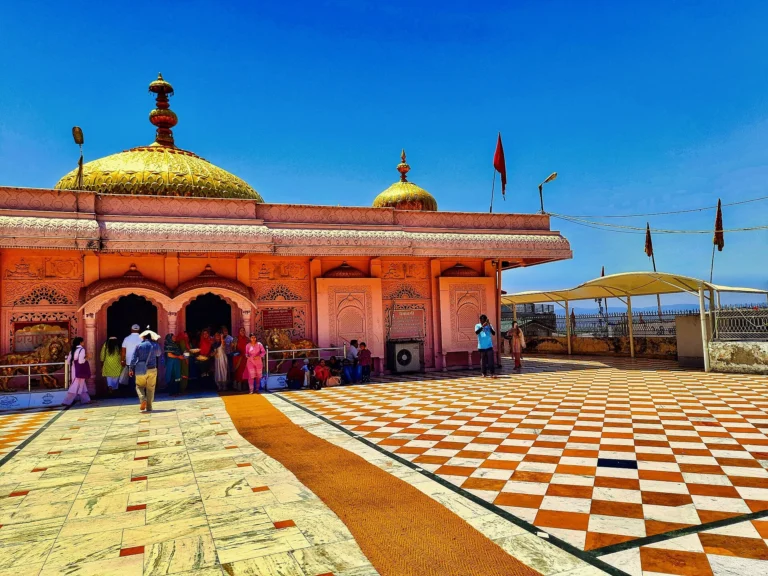 5 Shakti Peeths of HimachalNaina Devi to Chamunda in one loop
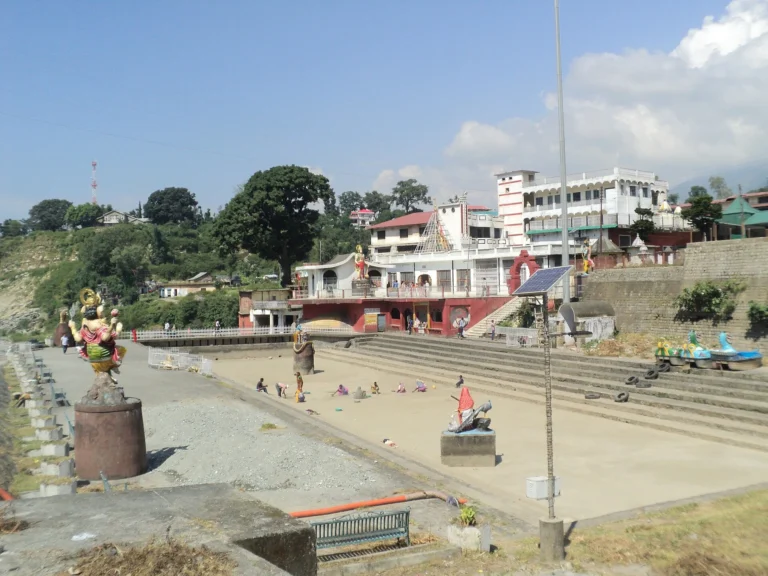 Chamunda Devi, KangraShiva and Shakti by the Baner river
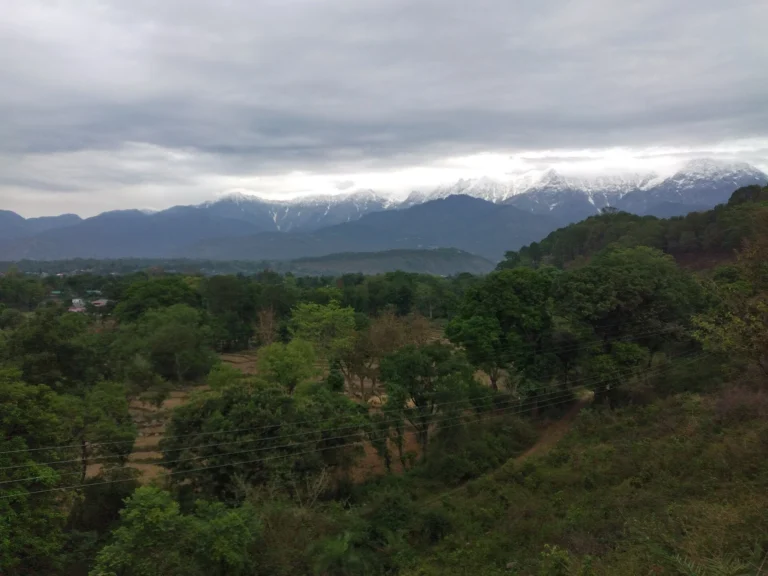 Kangra Devi (Brajeshwari)Shakti Peeth of Nagarkot, clad in butter
 Amarnath YatraIce lingam cave in the Kashmir HimalayaAll pilgrimage toursJyotirlingas, Shakti Peeths, Char Dham & more
Yatras & circuits
Seasonal yatras
Temple guides
Planning guides
Sources
- Manimahesh Yatra — Himachal Pradesh registration portal (official)
- Chamba district administration (official)
- Amar Ujala — Online registration for the Manimahesh Yatra begins (6 Aug 2026)
- The Tribune — Yatra culminates with the second royal bath (20 Sep 2026)
- News On AIR — Manimahesh Yatra officially starts on Janmashtami (26 Aug 2024)
- Drik Panchang — Radha Ashtami 2027
- Wikipedia — Manimahesh Lake
- Wikipedia — Bharmour
Photo credits
Golden domes of Jwala Ji over the temple courtyard — Photo: Ms Sarah Welch, CC0 · Chamunda Devi temple above the Baner river ghats — Photo: Ashish3724, CC BY-SA 3.0 · The Dhauladhar above the Kangra valley — Photo: Aaryan.kumar.rana, CC0 · The holy cave in its valley — Photo: Itzseoprasoon, CC BY-SA 4.0
Legends are retold in our own words as traditions. Animations are original artwork by Suzu Travels.