
Baijnath Temple, Himachal Pradesh: Story, Timings & How to Reach
बैजनाथ शिव मंदिरA stone shikhara below the snows of the Dhauladhar, a lingam Ravana is said to have carried, and a town that never burns his effigy.
Baijnath, in Kangra district of Himachal Pradesh, is one of the oldest living Shiva temples in the hills — raised in stone in 1204 CE where an older shrine already stood. Here is its legend, its history in inscriptions, the Shivratri fair, darshan tips and the easiest ways to reach it from Palampur, Bir and Dharamshala.
- 1204 CE present stone temple, per its inscriptions
- ~16 km from Palampur on the Pathankot–Mandi highway
- Open all year daily hours — confirm locally
- ASI protected monument
Where is Baijnath temple and why is it special?
Baijnath temple stands in Baijnath town, Kangra district, Himachal Pradesh, on the Binwa river below the Dhauladhar, about 16 km from Palampur. Shiva is worshipped here as Vaidyanath, the Lord of healers. The stone temple was built in 1204 CE by two merchants, Ahuka and Manyuka, and is an ASI-protected monument. It is open every day of the year.
The name says it all: Baijnath is the hill form of Vaidyanath — Shiva as the divine physician. The old town around the temple was once called Kiragrama. The temple is built in the North-Indian Nagara style, with a tall curved shikhara, a pillared hall with small balconies, carved niches and a Nandi at the porch. Smaller shrines, including Ganesha, Harihara and Kalyanasundara, stand in the courtyard. Devotees also believe the water of the nearby spring has healing power.
Not Baba Baidyanath Dham. This Baijnath in Himachal is a different temple from Baba Baidyanath Dham at Deoghar in Jharkhand, and from Parli Vaijnath in Maharashtra. Some local tradition counts Baijnath as the Vaidyanath Jyotirlinga, but most lists of the 12 Jyotirlingas place Vaidyanath at Deoghar. Either way, it is one of the most beautiful Shiva temples in the Himalaya — and an easy stop on a Kangra Devi yatra to Chamunda Devi and Kangra Devi.
The story of Baijnath temple
Retold in our own words from the traditions kept by the Kangra district and the temple — told as belief, not history. Versions differ.
- Penance on KailashRavana, it is said, pleased Shiva with fierce penance on Kailash and was allowed to carry Shiva, as a lingam, to Lanka — on one condition: it must never touch the ground on the way.
- Set down at KiragramaThe gods feared what Lanka would become. Near Kiragrama, tradition says, Ravana had to stop and handed the lingam to a passing shepherd — in some tellings Vishnu or Ganesha in disguise.
- Never moved againThe lingam was set down, and it could never be lifted again. Shiva stayed here, by the Binwa river below the Dhauladhar.
- The healerAnother strand says Ravana offered his heads in penance and Shiva healed him — and so he is worshipped here as Vaidyanath, the healer of all.
The recorded story is carved in stone. Two long Sanskrit inscriptions in the Sharada script inside the hall say that the present temple was built in 1204 CE by the merchants Ahuka and Manyuka, in the reign of King Jaya Chandra, and they show that an earlier Shiva temple stood on the same spot. Raja Sansar Chand of Kangra had the spire and outer roof rebuilt in 1786, and the main temple came through the great Kangra earthquake of 1905 with only minor damage. Today it is protected by the Archaeological Survey of India.
Because of Ravana’s devotion to Shiva here, Dussehra is traditionally not celebrated in Baijnath — no Ravana effigy is burnt and there is no Ramlila. Local belief holds that burning the effigy here brings misfortune, and it is often said that the town has no goldsmith’s shop. These are local beliefs, shared with respect.
Baijnath temple timings and darshan
| Open | Every day of the year |
| Darshan hours | Not published officially — confirm locally |
| Aarti | Times are not published officially — confirm locally |
| Busiest days | Maha Shivratri (state-level fair), Makar Sankranti and Vaisakha Sankranti |
| Registration | None needed for darshan |
Based on the Kangra district (HP government) page and the Ministry of Tourism Utsav portal, checked 23 Oct 2026. Timings vary by season — please confirm locally.
Baijnath Shivratri fair and festival dates
| What | Date | Status / source |
|---|---|---|
| Mahashivratri 2027 | 6 Mar 2027 | State-level Shivratri fair at Baijnath, run by SDM Baijnath with cultural evenings. 2027 fair programme: not announced yet |
| Makar Sankranti | Mid-January every year | Festival day at the temple |
| Vaisakha Sankranti | Mid-April every year | Festival day at the temple |
| Dussehra | Not celebrated | By local custom, no Ravana effigy is burnt in Baijnath |
We print a date only once it is confirmed. Mahashivratri follows the Hindu lunar calendar.
How to reach Baijnath temple
By road
Baijnath is on NH 154 (Pathankot–Mandi), about 16–17 km from Palampur, 12 km from Bir, 53 km from Dharamshala and 75 km from Mandi. HRTC and private buses run via Palampur; taxis from Pathankot, Dharamshala, Palampur and Bir.
By air
Gaggal (Kangra / Dharamshala) airport is about 55 km away.
By rail
Baijnath Paprola station on the Kangra Valley narrow-gauge line (Pathankot–Jogindernagar) is close to town — but service is often suspended after monsoon damage, so check the current status on NTES first. The nearest broad-gauge stations are Pathankot and Amb Andaura.
From our office
Ghumarwin, where our office is, is about 115 km away via the Mandi side — around 2 h 20 min by car.
A simple Baijnath and Kangra temples trip
-
Day 1Baijnath and Bir
Morning darshan at Baijnath; afternoon at Bir-Billing, about 12 km away. Night in Bir or Palampur.
-
Day 2Chamunda and Kangra Devi
Drive about 35 km to Chamunda Devi, then on to Brajeshwari (Kangra Devi). Night in Kangra or Dharamshala.
-
Day 3Jwala Ji or home
Continue to Jwala Ji and the Himachal Devi circuit, or fly home from Gaggal.
Every yatra is planned for your dates, group and pace — Price: Get Quote.
Before you go
- Easy for eldersIt is a town temple at road level, with only a few steps into the complex and a flat courtyard.
- Best seasonOpen all year. March–June and September–November are the most comfortable; winters are cold, with snow on the Dhauladhar.
- Where to stayBaijnath itself, Palampur or Bir — all within about 17 km.
- Combine itBir-Billing (about 12 km, paragliding), Palampur’s tea gardens (about 17 km), Chamunda Devi (about 35 km) and Kangra Devi (about 51 km).
Plan your Baijnath darshan with Suzu
Kangra is in our home hills. We can plan a Baijnath darshan with Palampur and Bir, a Shivratri fair visit, or add Baijnath to your Chamunda, Kangra Devi and Jwala Ji yatra.
Questions pilgrims ask
Where is Baijnath temple?
In Baijnath town, Kangra district, Himachal Pradesh, on the Binwa river below the Dhauladhar — about 16 km from Palampur on the Pathankot–Mandi highway.
Who built Baijnath temple?
Two local merchants, Ahuka and Manyuka, in 1204 CE, according to the Sanskrit inscriptions inside. An older Shiva shrine stood on the site before them.
Is Baijnath in Himachal a Jyotirlinga?
Some local tradition says so, but most Jyotirlinga lists place Vaidyanath at Deoghar in Jharkhand, with Parli Vaijnath in Maharashtra as the other main claim.
Why is Dussehra not celebrated in Baijnath?
Because of the belief that Ravana was a great devotee of Shiva here — so, by local custom, no Ravana effigy is burnt in Baijnath.
What are Baijnath temple timings?
The temple is open every day of the year. Daily hours and aarti times are not officially published, so please confirm locally.
When is the Baijnath Shivratri fair?
Around Maha Shivratri, as a state-level fair. Mahashivratri 2027 falls on 6 March 2027; the fair programme is not announced yet.
How do I reach Baijnath temple?
Fly to Gaggal (Kangra), about 55 km away, or drive via Palampur. The Kangra Valley toy train stops at Baijnath Paprola when it is running.
What to see near Baijnath?
Bir-Billing (about 12 km), Palampur tea gardens (about 17 km), Chamunda Devi (about 35 km) and Kangra Devi (about 51 km).
Keep exploring
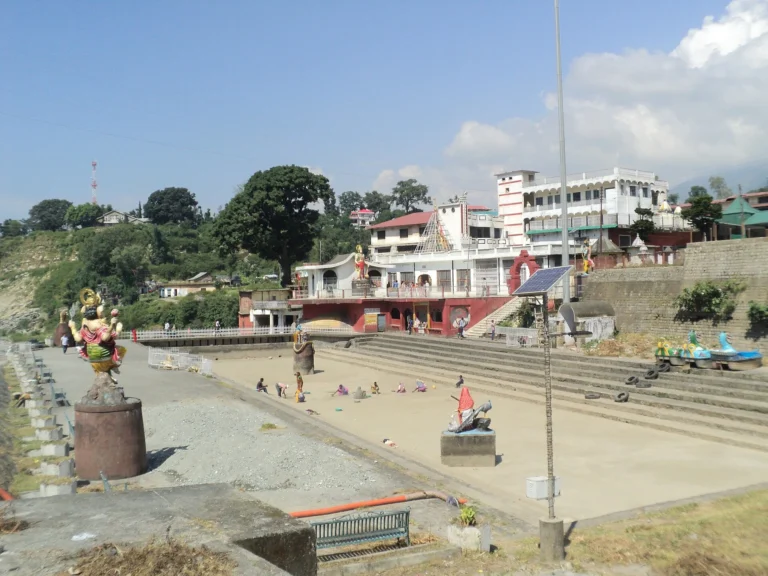 Chamunda Devi, KangraShiva and Shakti by the Baner river
 Kangra Devi (Brajeshwari)Shakti Peeth of Nagarkot, clad in butter
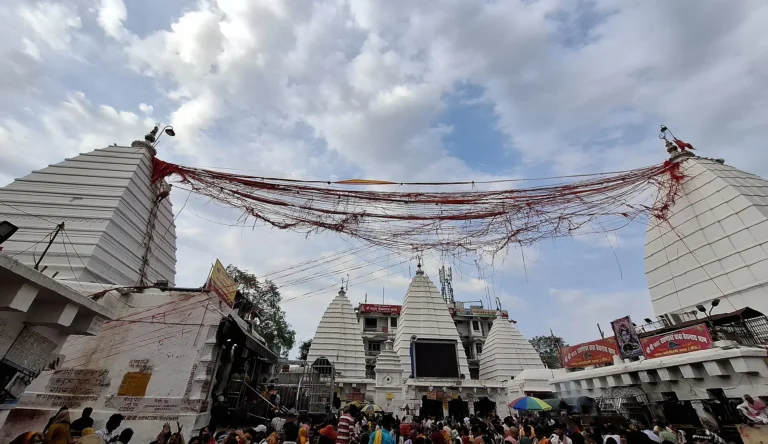 Baidyanath Dham, JharkhandJyotirlinga and Shakti Peeth in DeogharAll pilgrimage toursJyotirlingas, Shakti Peeths, Char Dham & more
Yatras & circuits
Seasonal yatras
Temple guides
Planning guides
Sources
- Kangra district (official) — Shiv Temple Baijnath
- Kangra district (official) — fairs and festivals
- Utsav, Ministry of Tourism — Baijnath Shivratri Fair
- ETV Bharat — Baijnath's tradition of not celebrating Dussehra (23 Oct 2020)
- The Tribune — Pathankot–Jogindernagar train service suspended due to rains
- Wikipedia — Baijnath Temple
Photo credits
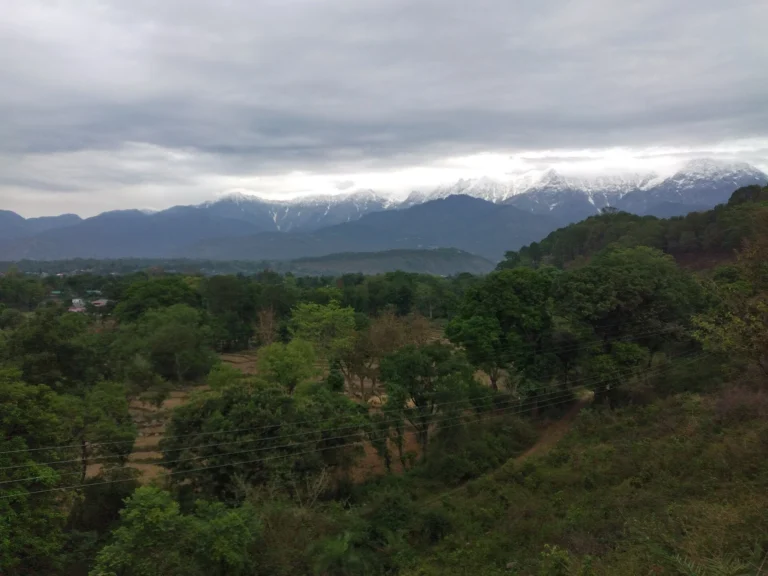
Chamunda Devi temple above the Baner river ghats — Photo: Ashish3724, CC BY-SA 3.0 · The Dhauladhar above the Kangra valley — Photo: Aaryan.kumar.rana, CC0 · The Baidyanath temple complex, Deoghar — Photo: Pinakpani, CC BY 4.0
Legends are retold in our own words as traditions. Animations are original artwork by Suzu Travels.