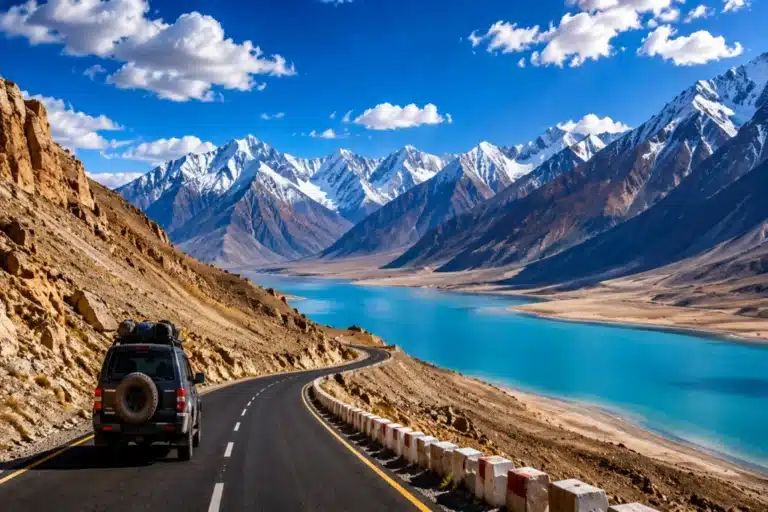

Himachal Pradesh has had its first real snow of the 2026-27 winter, and it arrived in September. The season’s first snowfall was recorded on 26 September 2026 in the Kuno-Charang belt of Kinnaur’s Pooh subdivision, and by 27 September it had spread across Lahaul-Spiti — Kaza, Losar and Tabo — along with Kalpa and Chitkul in Kinnaur. Temperatures in those pockets fell by 10 to 11 degrees. The Meteorological Centre, Shimla has a yellow warning in force for Kinnaur and Lahaul-Spiti until 29 September, with light to moderate snow likely at isolated places in the higher reaches on 28 September, rain continuing across the middle and lower hills, and dry weather expected from 30 September onwards.
If you are searching for snow in Manali or Shimla right now, the honest answer is no — not in the towns. What has changed is the altitude line, and that matters a great deal if you are travelling to Himachal in the next four weeks.
What actually happened, and when
Two separate snow events have hit the state this month. Keeping them apart matters, because a lot of what is circulating online has merged them into one.
| Date | Where it snowed | Detail |
|---|---|---|
| 17-18 September 2026 | Rohtang Pass, Baralacha, Shinkula | About four inches at Rohtang; higher reaches around Manali turned white. Traffic was moving on the passes at the time. |
| 26 September 2026 | Kuno-Charang area, Pooh subdivision, Kinnaur | Recorded as the season’s first snowfall by the Meteorological Centre, Shimla, along with light snow on some higher peaks. |
| 26-27 September 2026 | Kaza, Losar, Tabo (Spiti); Kalpa, Chitkul (Kinnaur) | Snow across the Spiti belt with a 10-11 degree temperature drop. Kalpa recorded the state’s lowest minimum at 3.8°C. |
In the same 24-hour window, Kalpa logged 45 mm of rain, Mandi 21.6 mm and Kufri 5 mm, while Una in the plains still touched 33.4°C. That spread — a hot afternoon in the lower belt and snow at 3,500 metres on the same day — is the defining feature of late September in the Himalayas, and it is exactly what catches unprepared travellers out.
Why it is raining below and snowing above at the same time
Because the monsoon has left the plains but not the mountains. In its bulletin issued 26 September 2026, the India Meteorological Department placed the southwest monsoon withdrawal line through Gurdaspur, Chandigarh, Muzaffarnagar, Aligarh, Dholpur, Udaipur, Deesa and Naliya. Punjab, Haryana and Delhi sit on the withdrawn side of that line. Himachal Pradesh and Uttarakhand do not.
So the same system is still feeding moisture into the western Himalaya, and with the freezing level now dropping, that moisture falls as rain in Mandi and as snow at Kaza. IMD’s own outlook for Himachal carried isolated heavy rainfall on 28 September and isolated to scattered rain through 2 October. For the wider picture of which parts of India are now dry and which are still waiting, our October travel guide built around this year’s monsoon withdrawal breaks it down region by region.
The Uttarakhand side of the same weather system was more severe: the Char Dham Yatra was suspended from the afternoon of 26 September under IMD red and orange warnings. We track that separately in our Char Dham Yatra status update.
The alert picture as of 27 September 2026
- Yellow warning, Kinnaur and Lahaul-Spiti: in force through 29 September, for snowfall in the higher reaches.
- 28 September: light to moderate snowfall likely at isolated places in the high reaches; rain across the middle and lower hills.
- Orange alert, Sirmaur: issued for 27 September for heavy to very heavy rainfall.
- Yellow alerts: Bilaspur, Mandi, Shimla, Solan and Kinnaur on 27 September; Shimla, Solan and Sirmaur on 28 September.
- Temperatures: minimums down 2-3°C, maximums down 2-4°C.
- From 30 September: dry weather expected across the state.
Two officials have said the same thing this month. DSP Keylong K D Sharma, on 27 September, said the winter season has begun and heavy snowfall can now hit high-altitude areas at any time, urging travellers to assess conditions before setting out. After the 18 September snow, Deputy Commissioner Kiran Bhadana asked tourists and motorists to check the weather before crossing Baralacha and Shinkula. Neither was a closure order — both were a warning that the window has changed.
Has Manali or Shimla had snow yet?
No. Manali town, Shimla, Kufri and Narkanda have had rain and a sharp temperature drop, not snow. What turned white is the ring of high ground above them — Rohtang and the passes beyond, and the Kinnaur-Spiti high desert.
That is the normal sequence. Town-level snow in Shimla and Manali usually arrives from late December through February, and the first dusting in the higher resort belt comes earlier. If you are booking a trip specifically to see snow, the month you pick matters far more than this week’s news does — our month-by-month guide to when it actually snows in Himachal sets out the realistic odds for each part of winter 2026-27.
One thing worth saying plainly: nobody can promise you snow on a given date. Any operator who does is selling you something they do not control.
What this means for your trip
If you are travelling in the next week
The lower and middle hills — Shimla, Kasauli, Dharamshala, Kullu, Manali town — are a rain problem, not a snow problem, through 29 September, and should clear from 30 September. Carry a rain layer, expect slower road time on the Mandi-Kullu stretch, and do not schedule a same-day arrival-and-sightseeing itinerary in that window. From 30 September the forecast turns dry, which makes early October a good bet for the standard Shimla-Manali circuit.
If you have Spiti, Kinnaur or a high pass on the itinerary
This is where the news actually bites. Once snow starts landing on Kunzum, Baralacha and Shinkula, the calculation changes from comfort to access: a single overnight fall can hold a pass for a day or more (our high-pass road status guide has each pass’s recent opening and closing dates), and vehicles get stranded on the wrong side of it. If you have a Spiti circuit, a Manali-Leh run or a Chandratal add-on planned for October, build in a spare day and agree a fallback route with your operator before you leave. Travel agents running the circuit this season should talk to a ground operator who handles Spiti directly rather than a re-seller, for the simple reason that when a pass shuts, you need someone with drivers and hotel contacts inside the valley, not a phone number in Delhi. Our winter Spiti guide covers what the valley is actually like once the passes go.
If you are planning October or booking now
Early snow is good news for the winter product and neutral for October. The Manali Hoteliers Association expects the snowfall to lift tourism activity, with the festive season already in view. For a traveller, October in Himachal after 30 September looks dry, clear and cold at night — the best combination of the year for photography and for high-altitude drives, provided you accept that the highest passes are now on borrowed time. If you want that circuit locked in before the passes close, our Himachal tour packages are built around the routes that stay open, and we will tell you straight if the one you have asked for is about to become impossible.
How to check road and pass status properly
We are deliberately not publishing a live “open or closed” list — a pass status written at 2 am is worthless by 9 am, and the aggregator sites that do publish one are usually weeks stale. Check it this way instead:
- The district administration for the district you are entering — Lahaul-Spiti, Kinnaur or Kullu — issues the closure orders that actually bind.
- The BRO and the state PWD for the Manali-Leh highway and the Shinkula and Baralacha stretches.
- The Meteorological Centre, Shimla for the alert colour on the day you travel, not the day you booked.
- Your hotel or operator inside the valley, on the morning of the drive. Someone standing in Kaza knows more than any website.
If you want a straight answer on whether a route is drivable on your dates, call us on 7087488961. We run these roads as a ground operator, and we would rather talk you out of a bad date than sell you a stranded trip.
FAQ
Has it snowed in Himachal Pradesh today?
Snow was recorded in Kinnaur on 26 September 2026 and across Lahaul-Spiti on 26-27 September. IMD forecast light to moderate snow at isolated places in the higher reaches on 28 September, under a yellow warning valid through 29 September. There has been no snow in Shimla, Manali town, Kufri or Dharamshala.
Is Spiti Valley open right now?
The Spiti belt was receiving snow on 26-27 September and vehicular movement was reported as moving at the time, but conditions at that altitude change within hours. Confirm with the Lahaul-Spiti district administration or an operator inside the valley on the morning you intend to drive, not days in advance.
Will the high passes close in October?
Closure dates are not fixed and are not announced in advance — they depend on when a heavy fall lands on Kunzum, Baralacha or Shinkula. What is certain is that from late September onward every high-pass crossing carries a real chance of a weather hold, so any October itinerary across one needs a buffer day.
Is early snowfall in September unusual for Himachal?
Snow at the high passes in the second half of September is not remarkable in itself — Rohtang saw about four inches on 17-18 September this year. What made the last week notable was that it reached the inhabited Spiti and Kinnaur belt, Kaza and Kalpa included, along with a 10-11 degree temperature crash.
Should I cancel a Himachal trip planned for early October?
On current forecasts, no. IMD expects dry weather across Himachal from 30 September. The part of an early-October plan worth revisiting is not whether to go, but whether a high-pass crossing still belongs in the itinerary and whether you have a spare day if it does.
Has the monsoon withdrawn from Himachal Pradesh?
Not as of the IMD bulletin issued 26 September 2026. The withdrawal line ran through Gurdaspur and Chandigarh, leaving Punjab, Haryana and Delhi on the withdrawn side and Himachal Pradesh and Uttarakhand still under monsoon influence — which is why rain continued in the hills after the plains had dried out.
Sources
- The Tribune, 27 September 2026 — Yellow alert for Kinnaur, Lahaul-Spiti as snowfall likely to continue till September 29
- The News Himachal, 26 September 2026 — Season’s first snowfall recorded in Kinnaur; orange alert for Sirmaur
- Daily Jagran, 27 September 2026 — Himachal witnesses season’s first snowfall in Lahaul-Spiti, Kinnaur
- The Tribune, 18 September 2026 — Himachal: First snow chills Kullu, Lahaul
- India Meteorological Department — national bulletin and monsoon withdrawal line, issued 26 September 2026
Weather and road conditions in the Himalayas change within hours. Every fact above is dated. Verify the alert colour and the road status for your own travel dates before you set out.