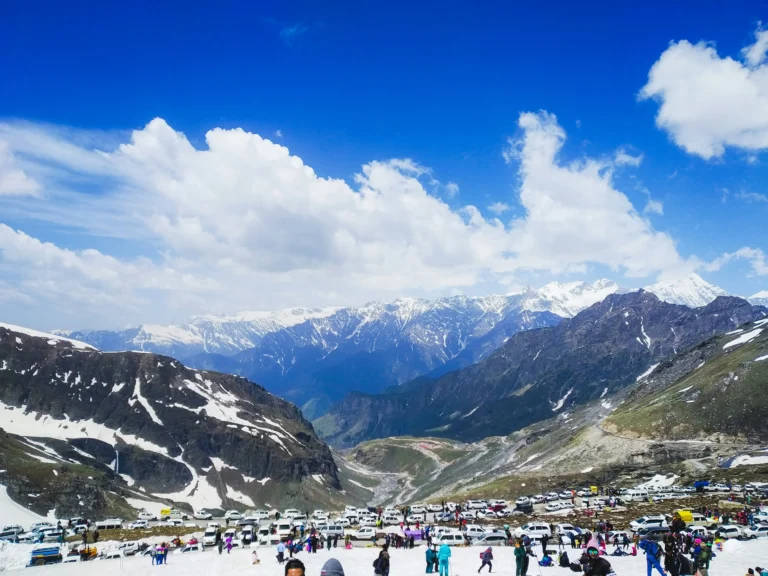

Spiti in winter is not a colder version of Spiti in summer. It is a different place. The Chandra Taal road is buried, the campsites are shut, most of the summer crowd is gone, and what remains is a frozen river valley at 3,800m with a few hundred people living through it.
It is one of the most remarkable trips you can take in India. It is also the one we turn people away from most often, because it genuinely does not suit everyone. This guide is written to help you decide honestly which group you are in.
There is only one way in
In summer, Spiti has two approaches and most people do the full circuit. In winter, one of them closes.
Closed: the Manali side. The Keylong-to-Kaza stretch over Kunzum Pass shuts under snow from roughly October or November and does not reopen until June or July. The Atal Tunnel keeps Lahaul accessible, but it does not get you to Kaza.
Open: the Shimla-Kinnaur approach, which stays serviceable through winter. The route runs Shimla → Narkanda → Rampur → Reckong Peo or Kalpa → Nako → Tabo → Kaza. It is longer, it gains altitude gradually, and that gradual climb is exactly what makes it the safer way in (compare the two roads in our Spiti via Shimla or Manali guide).
This means a winter Spiti trip is an in-and-out journey on the same road, not a loop. Budget the days accordingly — you cannot exit via Manali to save time.
What the cold actually looks like
| Month | Daytime | Night |
|---|---|---|
| November | 2 to 10°C | -5 to -12°C |
| December | -2 to 6°C | -10 to -20°C |
| January | -5 to 5°C | -15 to -25°C |
| February | -4 to 6°C | -12 to -22°C |
| March | 0 to 10°C | -5 to -15°C |
Read the night column carefully. At -20°C, water pipelines freeze. That is not a comfort problem you can book around — it is simply how the valley works in January.
What staying there is really like
Homestays in Kaza and the villages stay open through winter, and the hospitality is genuinely warm. The facilities are basic, and you should know that before you arrive rather than after.
- Hot water usually arrives in buckets once the pipes freeze. There is no shower in the way you mean it.
- Heating comes from a bukhari, the traditional stove. It heats one room well and the rest of the house not at all.
- Electricity can drop for a day or more after heavy snowfall. Carry a power bank and download what you want to watch.
- Toilets in many village homestays are dry composting toilets. They are clean and they work; they are not what most guests are used to.
Always confirm heating, water, meals and whether the house is actually staffed before booking. Some listings stay live online through a winter when the family has moved down to Kinnaur.
Altitude: the part people get wrong
Kaza sits around 3,800m. Villages like Komic and Langza go above 4,500m. Cold makes altitude sickness harder to spot, because you attribute the headache and the poor sleep to the temperature.
The rule we plan around: gain roughly 500m of sleeping altitude per night where the route allows, and add an extra acclimatisation night for about every 1,000m gained above 3,000m. The Shimla-Kinnaur route does this naturally if you do not rush it — which is why a night at Kalpa and a night at Nako or Tabo are not padding, they are the safety margin.
Medical facilities are limited. Kaza has a Community Health Centre, not a hospital. The nearest serious treatment is a long drive away on a winter road. Anyone with a heart condition, uncontrolled blood pressure or a respiratory problem should take medical advice before committing, and we would not recommend winter Spiti for young children or for guests over about 65.
The vehicle question
A capable SUV with snow chains and a driver who has done these roads in winter handles normal conditions. A 4×4 adds useful traction on fresh snow, icy climbs and slush — but no vehicle overrides a road closure or a police restriction, and no vehicle compensates for an inexperienced driver.
Self-drive in winter Spiti is something we actively discourage. The consequences of a mistake here are not a delay; there is no traffic behind you to help, and phone signal is patchy. Our winter Spiti runs use local drivers who grew up on this route.
About snow: nobody can promise it
You may arrive to a valley under deep, fresh powder. You may arrive during a dry spell with old crusty cover, brilliant blue skies and no snowfall at all for your entire stay. Both are normal. The frozen Spiti river, the monasteries at Key and Dhankar, and the light at that altitude are worth the journey either way — but go with the expectation of a cold desert, not a snow globe.
A realistic winter itinerary
Seven to eight days minimum from Shimla. Anything shorter either skips acclimatisation or leaves no margin for a road delay, and in winter you will eventually need that margin.
- Day 1: Shimla to Narkanda or Rampur
- Day 2: to Kalpa via Reckong Peo — first real altitude night
- Day 3: to Nako or Tabo
- Day 4: to Kaza, via Dhankar if conditions allow
- Day 5: Kaza base — Key Monastery, Kibber, Langza, Hikkim
- Day 6: buffer day, or the high villages if Day 5 was cut short
- Days 7-8: return the same way
Note the buffer day. On a winter Spiti trip it is not optional.
Permits and paperwork
Indian nationals do not need an Inner Line Permit for the main circuit — you register at the Sumdo, Losar and Jangi checkposts with a photo ID, several photocopies and your vehicle papers. Foreign nationals need a Protected Area Permit, valid 14 days, minimum group of two, with a sponsorship letter from a registered agency. There is also a Rs 150 per person ecological fee. The full breakdown is in our Himachal permits and entry tax guide.
Who should go, and who should not
Go if you have travelled at altitude before, you are genuinely comfortable being cold for several days, you can absorb a schedule change without it ruining the trip, and the idea of a village of forty people under snow is the point rather than the obstacle.
Do not go if this is your first Himalayan trip, if you are travelling with small children or elderly parents, if you have a fixed return flight with no slack, or if what you actually want is snow and comfort. In that case Manali with the Atal Tunnel, or Shimla with Narkanda, gives you the snow without the risk — see our winter snowfall guide. Or wait for summer and do the full Spiti circuit properly, which our Delhi to Spiti road trip guide covers.
Frequently asked questions
Is Spiti Valley open in winter?
Yes, via the Shimla-Kinnaur route, which stays open through the winter. The Manali route over Kunzum Pass is closed from around October or November until June or July.
How cold does Kaza get in January?
Nights typically fall between -15°C and -25°C, with daytime hovering around -5 to 5°C. Water pipelines freeze at these temperatures, so hot water comes in buckets.
Do I need a 4×4 for winter Spiti?
A capable SUV with snow chains and an experienced winter driver is sufficient in normal conditions. A 4×4 helps on fresh snow and icy climbs. Neither overrides an official road closure.
How many days do I need?
Seven to eight from Shimla, including at least one buffer day. Shorter trips either skip acclimatisation or leave no room for weather delays.
Can I see snow leopards in winter Spiti?
Winter is when the snow leopard descends to lower altitudes around Kibber, and dedicated tracking expeditions run in January and February with local spotters. Sightings are never guaranteed and require patience across several days — this is wildlife tracking, not a sightseeing stop.
Is winter Spiti safe?
It is safe when planned properly — gradual acclimatisation, an experienced driver, buffer days, and realistic expectations. It becomes risky when compressed into a short schedule or attempted self-drive by someone new to winter mountain roads.
Planning a winter Spiti trip
We run winter Spiti with local drivers, homestays we have verified are actually open and heated, and itineraries built around acclimatisation rather than around a brochure. If you tell us your dates and your experience level, we will tell you honestly whether we think it is the right trip for you — and if it is not, we will suggest something that is.
See our Spiti Valley tour packages or get in touch with your dates.
Selling Spiti rather than travelling yourself? We handle the ground for agents on net rates as a Spiti DMC — vehicles, verified winter homestays, permits and a named coordinator, all white-label under your own brand.